GTWY vs n8n
GTWY vs n8n: Why GTWY Is Built for the AI Era — Not Just Automation
Automation has entered a new phase.
We’re moving from rule-based workflows to intelligent systems that can understand context, make decisions, and evolve with each interaction.
Two platforms are often compared in this transition: n8n and GTWY.
They may look similar at the surface — both connect apps, run logic, and automate tasks — but at the architecture level, they are built for completely different worlds.
n8n is built for traditional automation.
GTWY is built for the intelligence era, where AI agents don’t just execute steps — they reason, collaborate, and adapt in real time.
The Shift: From Automation to Intelligence
n8n is a strong open-source automation engine. It excels at structured workflows:
send an email, update a CRM, post a Slack message, or move data between tools.
If your workflow is predictable and rule-based, n8n performs well.
But today’s systems are no longer predictable.
Businesses now rely on LLMs, autonomous agents, AI copilots, and systems that require context, memory, and reasoning.
The expectations have changed.
Automation alone isn’t enough.
This is the gap GTWY fills.
GTWY allows you to configure any LLM — GPT, Claude, Gemini, Llama — into a specialized AI agent with its own:
prompt logic
memory
tools
orchestration flow
contextual instructions
version control
And these agents can be deployed directly into your product using simple APIs or embed scripts.
It’s not just automation.
It’s full-stack AI Infrastructure for modern applications.
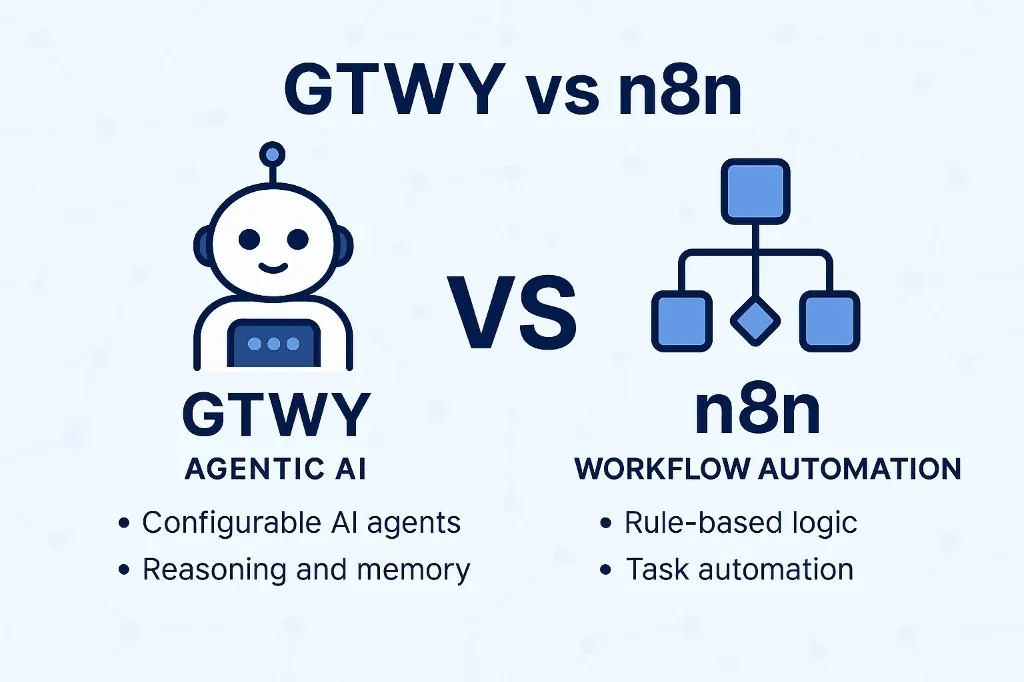
GTWY vs n8n: The Fundamental Differences
Below is the real distinction — not marketing, but architecture and capability.
Aspect | n8n | GTWY |
|---|---|---|
Core Purpose | Automation platform | AI Agent platform for reasoning-driven systems |
Integrations | Requires OAuth setups and connectors | Native instant integrations with no OAuth complexity |
AI Capabilities | AI is one node among many | AI agents are the foundation — with memory, reasoning, and orchestration |
Agent-to-Agent Communication | Not supported | Native A2A communication with orchestration logic |
Testing & Validation | No built-in test case system | Full Test Case framework to validate agent behavior |
Chatbot Output | Plain text only | Rich Text: buttons, lists, tables, structured outputs |
LLM Access | Requires external API setup and costs | All AI/ML services available instantly, free to start |
Deployment | Requires webhook setup and coding | One-click Embeds and ready-to-use APIs |
Coding Need | Low-code but often needs scripting | Pure low-code — no scripting, no JSON editing |
Scalability | Manual scaling | Built-in versioning, observability, and distributed agent scaling |
Why GTWY Defines the Next Generation of AI Platforms
GTWY extends beyond automation. It provides the core AI infrastructure required for modern applications:
1. Real-Time Reasoning
GTWY agents can analyze inputs, evaluate context, choose the right tool, and act intelligently — not just follow static logic.
2. Persistent Memory
Agents remember past decisions and conversations.
They don’t restart from zero.
3. Native Orchestration
Multiple agents can collaborate through structured A2A flows.
This makes GTWY suitable for complex decision systems, multi-agent architectures, and enterprise intelligence layers.
4. Production-Ready Stack
GTWY includes everything needed for deployment:
version control
debugging tools
test cases
observability
embeddings
rich outputs
multi-model support
real-time APIs
You can move from prototype → production in hours.
The Core Difference
It comes down to this:
One executes rules.
The other understands context.
One connects apps.
The other becomes the brain that coordinates them.
Final Word
If your goal is simple, linear automation, n8n is an excellent tool.
But if you want to build intelligent systems —
systems that think, communicate, collaborate, and evolve —
then GTWY is built for you.
GTWY isn’t the next version of automation.
It’s the platform for the intelligence era, where your workflows don’t just run — they understand.
 Built with DocStar