Configuring Dynamic API Payloads
Step-by-Step Guide to Dynamic Payloads for Chat Completion APIs
Static payloads are fine for simple demos, but real apps need flexibility. A dynamic payload is a JSON object you build at runtime so you can change models, prompts, tools, and settings without editing code. This makes your chatbot scalable, adaptable, and easier to maintain.
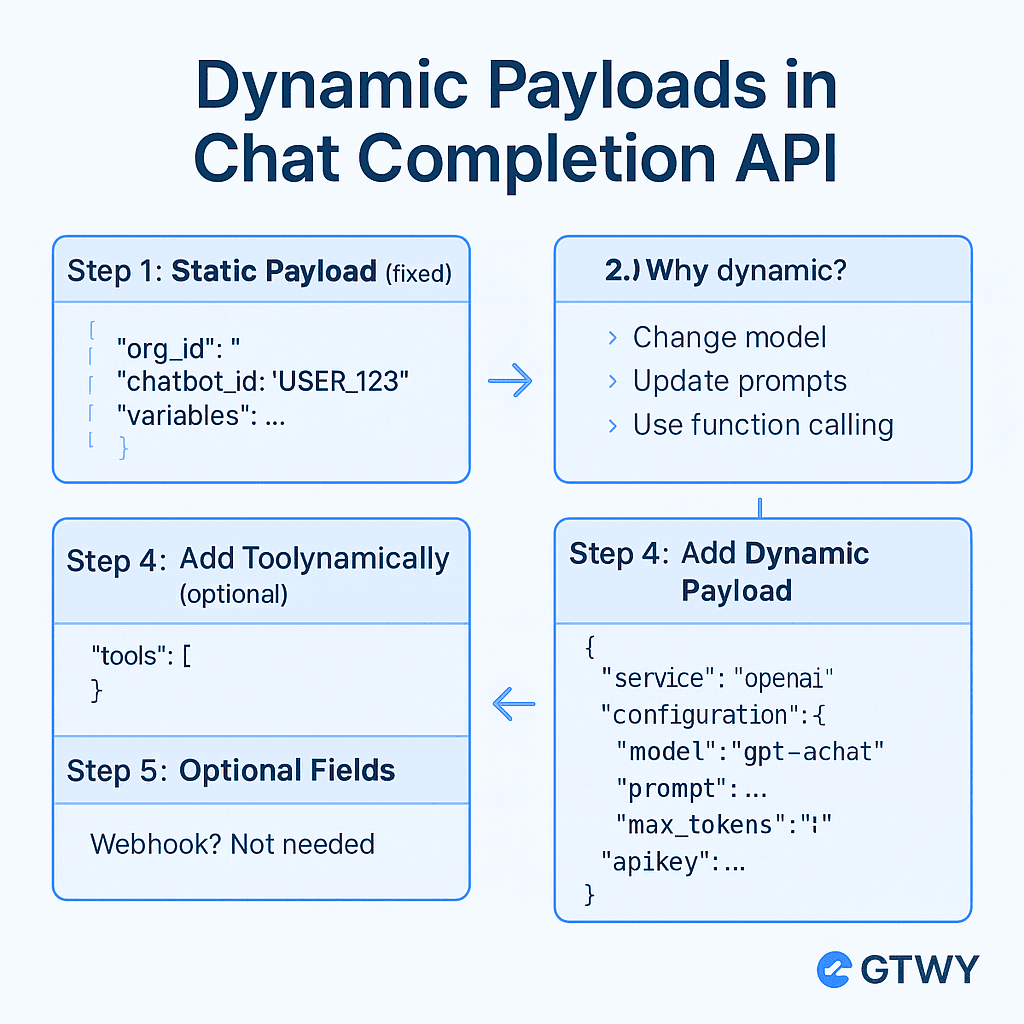
1. What is a static chatbot payload?
A static payload is a fixed JSON you always send to the API:
{
  "org_id": "ORG_123",
  "chatbot_id": "BOT_456",
  "user_id": "USER_123",
  "variables": {
    "name": "abc"
  }
}
Problems with static payloads:
Model, prompt, and tools are hardcoded.
Changing behavior requires code edits and redeploys.
Not suitable for multi-tenant or multi-model setups.
2. Why use a dynamic payload?
Dynamic payloads let you:
Switch models (for cost vs. capability trade-offs).
Update prompts per user language, role, or context.
Add function-calling tools only when needed.
Adjust temperature, token limits, or other runtime parameters.
Keep optional fields out of the request unless required (keeps payloads small).
3. Core dynamic payload structure
Build a JSON at runtime with configuration fields. Example structure:
{
  "service": "openai",
  "configuration": {
    "model": "gpt-4o",
    "type": "chat",
    "prompt": "Act as a JSON response bot",
    "max_tokens": 1024,
    "temperature": 0.7
  },
  "apikey": "your-api-key"
}
Key fields to customize:
model— which LLM to use (e.g.,gpt-4o,gpt-3.5).prompt— the system/user instructions that define behavior.tools— optional list of functions or integrations.max_tokens— maximum response length.temperature— controls creativity/variance.other optional fields— e.g.,response_count,log_probability.
4. Add tools (function calling) only when needed
If a response requires external logic (calculators, DB queries, third-party APIs), include a tools section dynamically:
"tools": [
  {
    "type": "function",
    "id": "66aa1347f6048aaaf9e5d34b",
    "name": "calculate_bmi",
    "description": "Calculate BMI from weight and height",
    "required": ["weight", "height"],
    "properties": {
      "weight": { "type": "number" },
      "height": { "type": "number" }
    }
  }
]
Only add tools when the current prompt or user action needs them — this keeps other requests lightweight.
5. Keep optional fields optional
Don’t send optional fields unless needed. Common optional fields include:
system_prompt_version_idlog_probabilityrepetition_penaltyresponse_count
Including unnecessary fields increases payload size and can complicate downstream handling.
6. Example: Build payload at runtime (pseudo-code)
function buildPayload(userContext) {
  const base = {
    service: "openai",
    configuration: {
      model: userContext.preferredModel || "gpt-4o",
      type: "chat",
      prompt: generatePrompt(userContext),
      max_tokens: userContext.maxTokens || 512,
      temperature: userContext.temperature ?? 0.5
    },
    apikey: process.env.API_KEY
  };

  if (userContext.needsTools) {
    base.configuration.tools = buildTools(userContext.toolsConfig);
  }

  if (userContext.includeTelemetry) {
    base.configuration.log_probability = 0;
  }

  return base;
}
7. Testing and safety tips
Validate dynamic values before sending (model names, numeric ranges).
Sanitize user input inserted into prompts to avoid injection issues.
Rate-limit and monitor usage when switching to more powerful/expensive models.
Use feature flags or admin controls to test new models or tools safely.
8. Final takeaway
Dynamic payloads give your chatbot freedom.
You control behavior, tools, and models at runtime — without rebuilding or redeploying.
This is how you scale AI systems intelligently.
 Built with DocStar